|
|||
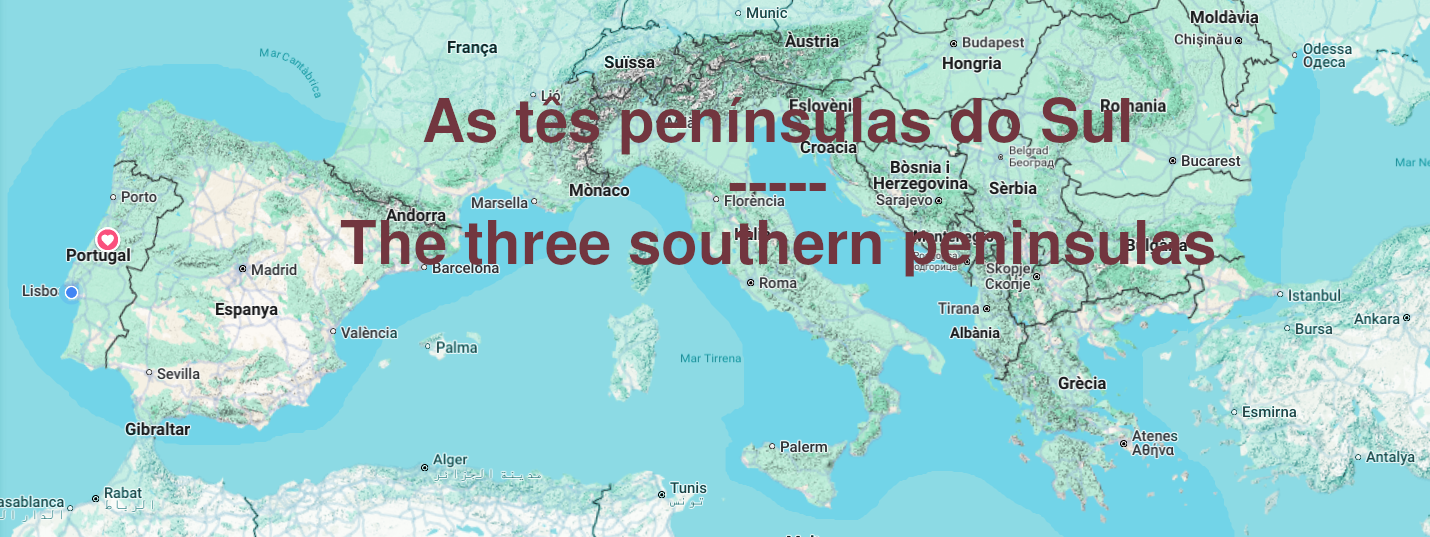
Antes de observarmos e classificarmos a estatuária urbana por areas administrativas, por países e regiões mais ou menos autónomas, podemos e devemos observar territórios mais amplos definidos pelas suas características geofísicas e históricas. É o caso das três penínsulas mais a Oeste do Sul da Europa e as mais significativas no quadro da união Europeia. Em termos históricos já há uma cola que as une, além dos aspetos climáticos e geofísicos, trata-se dos dois terços mais a Oeste, da margem Norte do chamado “Mare Nostrum” do período imperial romano. Com as penínsulas Ibérica e Itálica e o Norte da costa Leste do Mar Adriático inscritos no império do ocidente, com capital em Roma; enquanto a quase totalidade restante da península Balcânica fica vinculada ao império romano do oriente com a sua capital na antiga Bizâncio que se torna Constantinopla. Também o império Otomano chegou até à Macedónia do Norte, com Bitola como cidade bastante importante da administração regional. Portanto, além de traços climáticos e de relevo em comum, que já em si definem sensibilidades e personalidades em comum, tem a marca cultural do império, ainda visível em muita arquitetura. E também a camada de referente da cultura otomana, do império otomano e das migrações eslavas e do império russo. A cultura balcânica é riquíssima e muito variada denotando a mistura das influências orientais árabes e muçulmanas por via do império otomano, com os povos vindo do leste junto com influências gregas, etruscas e romanas. Estas três penínsulas, Ibérica, Itálica e Balcânica são o Sudoeste europeu. Com cadeias montanhosas nos istmos ou mais adiante de forma adjacente, os Pirenéus, os Alpes, os Cárpatos. A Península Ibérica é o extremo ocidente da Europa. Este é o espaço geográfico por onde se distribui uma quantidade significativa de obras de estatuária urbana, as quais, na larga maioria, têm qualidade plástica e fortuna significante; histórica, etnográfica, identitária bastante, para que mereçam uma classificação conjunta no domínio do património cultural local da humanidade. É bom notar que estamos perante património imóvel disposto territorialmente e assinalando geografias culturais e etnemas, com uma forte capacidade educativa e promotora da coesão social, nos países, regiões e comunidades em que se inscrevem. Com levantamentos “in situ” nestas regiões peninsulares e no Ocidente Norte e Centro europeu, França, Andorra, BENELUX, Alemanha, Áustria, Dinamarca, Suécia e regiões próximas, permite fazer uma comparação entre estas duas grandes regiões do Centro e Oeste europeu. E há diferença entre todas estas regiões: na escala das composições, na cor do bronze ou no tipo de pedra, na predominância temática, entre outros aspetos. A larga maioria da escultura urbana, tem em comum, independentemente da sua localização geográfica, o facto de serem obra de escultor notável e de uma escola, faculdade ou academia de Belas-Artes e a transmissão de um episódio local. Vamos pois observar as constantes e variáveis da estatuária urbana nestas três territórios peninsulares. |
Before observing and classifying urban statuary by administrative areas, by countries and more or less autonomous regions, we can and should observe broader territories defined by their geophysical and historical characteristics. This is the case of the three westernmost peninsulas in Southern Europe and the most significant within the European Union. In historical terms, there is already a glue that unites them, in addition to the climatic and geophysical aspects, this is the westernmost two-thirds, the northern margin of the so-called “Mare Nostrum” from the Roman imperial period. With the Iberian and Italian peninsulas and the North of the East coast of the Adriatic Sea included in the Western Empire, with its capital in Rome; while almost the entire remaining Balkan peninsula is linked to the Eastern Roman Empire with its capital in ancient Byzantium, which becomes Constantinople. The Ottoman Empire also covered North Macedonia, with Bitola as a very important city in the regional administration. Therefore, in addition to common climate and relief features, which in themselves define common sensibilities and personalities, it has the cultural mark of the empire, still visible in much architecture. And also the referent layer of Ottoman culture, the Ottoman empire and Slavic migrations and the Russian empire. Balkan culture is very rich and very varied, denoting the mixture of Arab and Muslim eastern influences through the Ottoman Empire, with people coming from the east along with Greek, Etruscan and Roman influences. These three peninsulas, Iberian, Italian and Balkan, are Southwest Europe. With mountain ranges on the isthmuses or further adjacent, the Pyrenees, the Alps, the Carpathians. The Iberian Peninsula is the westernmost tip of Europe. This is the geographic space where a significant amount of urban statuary works are distributed, the vast majority of which have plastic quality and significant fortune; historical, ethnographic and identity enough to deserve a joint classification in the domain of the local cultural heritage of humanity. It is worth noting that we are faced with immovable heritage arranged territorially and marking cultural geographies and ethnicities, with a strong educational capacity and promoting social cohesion, in the countries, regions and communities in which they are located. With “in situ” surveys in these peninsular regions and in Western North and Central Europe, France, Andorra, BENELUX, Germany, Austria, Denmark, Sweden and nearby regions, it allows a comparison to be made between these two large regions of Central and Western Europe. And there are differences between all these regions: in the scale of the compositions, in the color of the bronze or the type of stone, in the thematic predominance, among other aspects. The vast majority of urban sculptures have in common, regardless of their geographic location, the fact that they are the work of a notable sculptor and from a school, college or academy of Fine Arts and the broadcast of a local episode. Let us then observe the constants and variables of urban statuary in these three peninsular territories. |
||
|
|
||